This is a special post towards International Women's Day (March 8th). Every year I find myself enthusiastically conveying my thoughts about the topic to the people around me, so I thought I might as well share it with a broader audience. As always, this post presents my very limited knowledge/interpretation to a broadly discussed and studied topic. However, it may be a bit off topic for this blog, so if you're only interested in computational stuff, you can focus on section 3.
1. The Problem
Even though we are half of the population, women are quite poorly represented in STEM:
2. The Causes (and possible solutions)
2.1 Cognitive Differences
There is a common conception that female abilities in math are biologically inferior to those of males. Many highly cited psychology papers prove differently, for example:
"Stereotypes that girls and women lack mathematical ability persist, despite mounting evidence of gender similarities in math achievement." [1].
"...provides evidence that mathematical and scientific reasoning develop from a set of biologically based cognitive capacities that males and females share. These capacities lead men and women to develop equal talent for mathematics and science." [2]
1. The Problem
Even though we are half of the population, women are quite poorly represented in STEM:
| USA: the percentage of computing occupations held by women has been declining since 1991, when it reached a high of 36%. The current rate is 25%. [2016, here] OECD member countries: While women account for more than half of university graduates in scientific fields in several OECD countries, they account for only 25% to 35% of researchers in most OECD countries. [2006, here] |
2. The Causes (and possible solutions)
2.1 Cognitive Differences
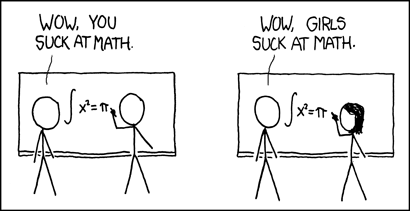
There is a common conception that female abilities in math are biologically inferior to those of males. Many highly cited psychology papers prove differently, for example:
"Stereotypes that girls and women lack mathematical ability persist, despite mounting evidence of gender similarities in math achievement." [1].
"...provides evidence that mathematical and scientific reasoning develop from a set of biologically based cognitive capacities that males and females share. These capacities lead men and women to develop equal talent for mathematics and science." [2]
 |
| From https://imgs.xkcd.com/comics/how_it_works.png. |
In addition, if cognitive differences were so prominent, there wouldn't be so many women graduating in scientific fields. It seems that the problem lies in occupational gender segregation, which may be explained by any one of the following:
2.2 Family Life
Here are some references from studies conducted about occupational gender segregation:
Here are some references from studies conducted about occupational gender segregation:
"In some math-intensive fields, women with children are penalized in promotion rates." [3]
"women may “prefer” those [jobs] with flexible hours in order to allow time for childcare, and may also “prefer” occupations which are relatively easy to interrupt for a period of time to bear or rear children." [5] (the quotation marks are later explained, indicating that this is not a personal preference but rather influenced by learned cultural and social values).
I'd like to focus the discussion now on my local point view of the situation in Israel, since I suspect that it is the most prominent cause of the problem here. I would be very interested in getting comments regarding what it is like in other countries.
According to the Central Bureau of Statistics, in 2014, 48.9% of the workers in Israel were women (and 51.1% were men). The average salary was 7,439 NIS for women and 11,114 for men. Wait, what?... let me introduce another (crucial) factor.
Of course, things get much worse when you consider sexual harassment in workplaces. I know the awareness to the subject is very high today, an employer's duty to prevent sexual harassment is statutory in many countries, and many big companies require new employees to undergo a sexual harassment prevention training. While this surely mitigates the problem, it is still too common, with a disturbing story just from the last week (and many other stories untold). As with every other law, there will always be people breaking it, but it is the employers' duty to investigate any reported case and handle it even at the cost of losing a valuable worker.
2.4 Gender Stereotypes
Simply because it's so difficult to change reality; even if some of the reasons why women were previously less likely to work in these industries are no longer relevant, girls will still be less oriented to working in these fields since they are considered unsuitable for them.
An interesting illustration was provided in this work, where 26 girls (around 4 years old) were shown different Barbie dolls and asked whether they believed women could do masculine jobs. When the Barbie dolls were dressed in "regular" outfits, many of them replied negatively, but after being showed a Barbie dressed up in a masculine outfit (firefighter, astronaut, etc.), the girls believed that they too could do non-stereotypical jobs.
This is the vicious circle that people are trying to break by encouraging young girls to study scientific subjects and supporting woman already working in these fields. Specifically, by organizing women-only conferences, offering scholarships for women, and making sure that there is a female representative in any professional group (e.g. panel, committee, etc). While I understand the rational behind changing the gender distribution, I often feel uncomfortable with these solutions. I'll give an example.
"women may “prefer” those [jobs] with flexible hours in order to allow time for childcare, and may also “prefer” occupations which are relatively easy to interrupt for a period of time to bear or rear children." [5] (the quotation marks are later explained, indicating that this is not a personal preference but rather influenced by learned cultural and social values).
I'd like to focus the discussion now on my local point view of the situation in Israel, since I suspect that it is the most prominent cause of the problem here. I would be very interested in getting comments regarding what it is like in other countries.
 |
| From http://explosm.net/comics/2861/ |
According to the Central Bureau of Statistics, in 2014, 48.9% of the workers in Israel were women (and 51.1% were men). The average salary was 7,439 NIS for women and 11,114 for men. Wait, what?... let me introduce another (crucial) factor.
While the fertility rate has decreased in all other OECD member countries, in Israel it remained stable for the last decade, with an average of 3.7 children per family. On a personal note, as a married woman without children, I can tell you that it is definitely an issue, and "when are you planning to have children already?" is considered a perfectly valid question here, even from strangers (and my friends with 1 or 2 children often get "when do you plan to have the 2nd/3rd child?").
Paid maternity leave is 14 weeks with a possibility (used by anyone who can afford it) to extend it to 3 more unpaid months. Officially, any one of the parents can take maternity leave, but in practice, since this law was introduced in 1998, only roughly 0.4% of the parents who took maternity leave were fathers.
Here is the number connecting the dots, and explaining the salary gap: in 2014, the average number of work hours per week was 45.2 for men and 36.7 for women. The culture in Israel is torn between the traditional family roles (mother as a main parent) and the modern opportunities for women. Most women I know have a career in the morning, and a second job in the afternoon with the kids. With a hard constraint of leaving work before 16:00 to pick up the kids, in a demanding market like in Israel, it is much harder for a woman to get promoted. It poses the high-tech industry, in which the working hours are known to be long, as a male-dominated environment. Indeed, in 2015, only 36.2% of the high-tech workers in Israel were women.
This situation is doubly troubling: on the one hand, it is difficult for women who do choose demanding careers. They have to juggle between home and work in a way that men are never required to. On the other hand, we are oriented since childhood to feminine occupations that are less demanding in working hours.
Don't get me wrong, I'm not here to judge. Being a feminist doesn't entail that the woman must have a career while the man has to stay at home with the children. Each couple can decide on their division of labor as they wish. It's the social expectations and cultural bias that I'm against. I've seen this happening time after time: the man and the woman both study and build up their careers, they live in equality, and then the birth of their first child, and specifically maternity leave, is the slippery slope after which equality is a fantasy.
To make a long story short, I think it is not women the market is against, but mothers. When I say "against" I include allegedly good ideas such as allowing a mother to leave work at 16:00. While I'm not against leaving work at 16:00 (modern slavery is a topic for another discussion...), I don't see why this "privilege" should be reserved only for mothers. In my humble opinion, it will benefit mothers, fathers, children and the market if men and women could each get 3 days a week to leave work as "early" as at 16:00. It wouldn't hurt if both men and women will have the right to take parental leave together, developing their parenthood as a shared job. This situation will never change unless the market will overcome ancient society rules and stop treating parenthood as a job for women.
2.3 Male-dominated Working Environments
Following the previous, tech workplaces (everywhere) are dominated by men, so that even women who choose to work in this industry might feel uncomfortable in their workplaces. Luckily for me I can't attest this by my own experience: I've never been treated differently as a woman, and have never felt threatened or uncomfortable in situations in which I was an only woman. This article exemplifies some of the things that other women experienced:
"Many [women] will say that their voice is not heard, they are interrupted or ignored in meetings; that much work takes place on the golf course, at football matches and other male-dominated events; that progress is not based on merit and women have to do better than men to succeed, and that questions are raised in selection processes about whether a woman “is tough enough”."
2.3 Male-dominated Working Environments
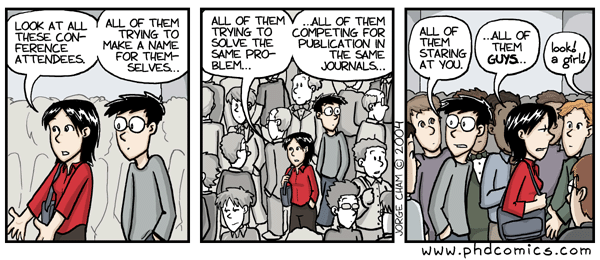
Following the previous, tech workplaces (everywhere) are dominated by men, so that even women who choose to work in this industry might feel uncomfortable in their workplaces. Luckily for me I can't attest this by my own experience: I've never been treated differently as a woman, and have never felt threatened or uncomfortable in situations in which I was an only woman. This article exemplifies some of the things that other women experienced:
"Many [women] will say that their voice is not heard, they are interrupted or ignored in meetings; that much work takes place on the golf course, at football matches and other male-dominated events; that progress is not based on merit and women have to do better than men to succeed, and that questions are raised in selection processes about whether a woman “is tough enough”."
 |
| From http://www.phdcomics.com/comics/archive.php?comicid=490 |
Of course, things get much worse when you consider sexual harassment in workplaces. I know the awareness to the subject is very high today, an employer's duty to prevent sexual harassment is statutory in many countries, and many big companies require new employees to undergo a sexual harassment prevention training. While this surely mitigates the problem, it is still too common, with a disturbing story just from the last week (and many other stories untold). As with every other law, there will always be people breaking it, but it is the employers' duty to investigate any reported case and handle it even at the cost of losing a valuable worker.
Simply because it's so difficult to change reality; even if some of the reasons why women were previously less likely to work in these industries are no longer relevant, girls will still be less oriented to working in these fields since they are considered unsuitable for them.
 |
| From https://www.facebook.com/DoodleTimeSarah/ |
An interesting illustration was provided in this work, where 26 girls (around 4 years old) were shown different Barbie dolls and asked whether they believed women could do masculine jobs. When the Barbie dolls were dressed in "regular" outfits, many of them replied negatively, but after being showed a Barbie dressed up in a masculine outfit (firefighter, astronaut, etc.), the girls believed that they too could do non-stereotypical jobs.
This is the vicious circle that people are trying to break by encouraging young girls to study scientific subjects and supporting woman already working in these fields. Specifically, by organizing women-only conferences, offering scholarships for women, and making sure that there is a female representative in any professional group (e.g. panel, committee, etc). While I understand the rational behind changing the gender distribution, I often feel uncomfortable with these solutions. I'll give an example.
Let's say I submitted a paper to the main conference in my field, and that paper was rejected. Then somebody tells me "there's a women-only workshop, why don't you submit your paper there?". If I submit my paper there and it gets accepted, how can I overcome the feeling of "my paper wasn't good enough for a men's conference, but for a woman's paper it was sufficient"?
For the same reason, I'm uncomfortable with affirmative action. If I'm a woman applying for a job somewhere and I find out that they prefer women, I might assume that there was a man who was more talented/adequate than me but they settled for me because I was a woman. If that's true, it is also unfair for that man. In general, I want my work to be judged solely based on its quality, preferably without taking gender into consideration, for better and for worse.
I know I'm presenting a naive approach and that in practice, gender plays a role, even if subconsciously. I also don't really have a better solution for that, but I do hope that if we take care of all the other reasons I discussed, this distribution will eventually change naturally.
I know I'm presenting a naive approach and that in practice, gender plays a role, even if subconsciously. I also don't really have a better solution for that, but I do hope that if we take care of all the other reasons I discussed, this distribution will eventually change naturally.
3. Statistics and Bias
Last year there was an interesting paper [6], followed by a lengthy discussion, about gender stereotypes in word embeddings. Word embeddings are trained with the objective of capturing meaning through co-occurrence statistics. In other words, words that often occur next to the same neighboring words in a text corpus are optimized to be close together in the vector space. Word embeddings have proved to be extremely useful for many downstream NLP applications.
The problem that this paper presented was that these word embeddings capture also "bad" statistics, for example gender stereotypes with regard to professions. For instance, word embeddings have a nice property of capturing analogies like "man:king :: woman:queen", but these analogies contain also gender stereotypes like "father:doctor :: mother:nurse", "man:computer programmer :: woman:homemaker", and "he:she :: pilot:flight attendant".
Why this is happening is pretty obvious - word embeddings are not trained to capture "truth" but only statistics. If most nurses are women, they would occur in the corpus next to words that are more likely to occur with feminine words than with masculine words, resulting in higher similarity between nurse and woman than nurse and man. In other words, if the input corpus reflects stereotypes and biases of society, so will the word embeddings.
So why is this a problem, anyway? Don't we want word embeddings to capture the statistics of the real world, even the kind of statistics we don't like? If something should be bothering us, it is the bias in society, rather than the bias these word embeddings merely capture. Or in other words:
I like this tweet because I was wondering just the same when I first heard about this work. The key concern about bias in word embeddings is that these vectors are commonly used in applications, and this might inadvertently amplify unwanted stereotypes. The example in the paper mentions web search aided by word embeddings. The scenario described is of an employer looking for an intern in computer science by searching for terms related to computer science, and the authors suggest that a LinkedIn page of a male researcher might be ranked higher in the results than that of a female researcher, since computer science terms are closer in the vector space to male names than to female names (because of the current bias). In this scenario, and in many other possible scenarios, the word embeddings are not just passively recording the gender bias, but might actively contribute to it!
The problem that this paper presented was that these word embeddings capture also "bad" statistics, for example gender stereotypes with regard to professions. For instance, word embeddings have a nice property of capturing analogies like "man:king :: woman:queen", but these analogies contain also gender stereotypes like "father:doctor :: mother:nurse", "man:computer programmer :: woman:homemaker", and "he:she :: pilot:flight attendant".
Why this is happening is pretty obvious - word embeddings are not trained to capture "truth" but only statistics. If most nurses are women, they would occur in the corpus next to words that are more likely to occur with feminine words than with masculine words, resulting in higher similarity between nurse and woman than nurse and man. In other words, if the input corpus reflects stereotypes and biases of society, so will the word embeddings.
So why is this a problem, anyway? Don't we want word embeddings to capture the statistics of the real world, even the kind of statistics we don't like? If something should be bothering us, it is the bias in society, rather than the bias these word embeddings merely capture. Or in other words:
What's this deal with de-biasing embeddings? Shouldn't we rather let embeddings as is and aim at de-biasing society instead?— Angeliki Lazaridou (@aggielaz) September 30, 2016
I like this tweet because I was wondering just the same when I first heard about this work. The key concern about bias in word embeddings is that these vectors are commonly used in applications, and this might inadvertently amplify unwanted stereotypes. The example in the paper mentions web search aided by word embeddings. The scenario described is of an employer looking for an intern in computer science by searching for terms related to computer science, and the authors suggest that a LinkedIn page of a male researcher might be ranked higher in the results than that of a female researcher, since computer science terms are closer in the vector space to male names than to female names (because of the current bias). In this scenario, and in many other possible scenarios, the word embeddings are not just passively recording the gender bias, but might actively contribute to it!
Hal Daumé III wrote a blog post called Language Bias and Black Sheep about the topic, and suggested that the problem goes even deeper, since corpus co-occurrences don't always capture real-world co-occurrences, but rather statistics of things that are talked about more often:
"Which leads us to the "black sheep problem." We like to think that language is a reflection of underlying truth, and so if a word embedding (or whatever) is extracted from language, then it reflects some underlying truth about the world. The problem is that even in the simplest cases, this is super false."
Prior to reading this paper (and the discussion and blog posts that followed it), I never realized that we are more than just passive observers of data; the work we do can actually help mitigate biases or inadvertently contribute to them. I think we should all keep this in mind and try to see in our next work whether it can have any positive or negative affect on that matter -- just like we try to avoid overfitting, cherry-picking, and annoying reviewer 2.
References:
[1] Cross-national patterns of gender differences in mathematics: A meta-analysis. Else-Quest, Nicole M.; Hyde, Janet Shibley; Linn, Marcia C. Psychological Bulletin, Vol 136(1), Jan 2010, 103-127.
[2] Sex Differences in Intrinsic Aptitude for Mathematics and Science?: A Critical Review. Spelke, Elizabeth S. American Psychologist, Vol 60(9), Dec 2005, 950-958.
[3] Women's underrepresentation in science: Sociocultural and biological considerations. Ceci, Stephen J.; Williams, Wendy M.; Barnett, Susan M. Psychological Bulletin, Vol 135(2), Mar 2009, 218-261.
[4] Why don't they want a male-dominated job? An investigation of young women who changed their occupational aspirations. Pamela M. Frome, Corinne J. Alfeld, Jacquelynne S. Eccles, and Bonnie L. Barber. Educational Research And Evaluation Vol. 12 , Iss. 4,2006
[5] Women, Gender and Work: What Is Equality and How Do We Get There? Loutfi, Martha Fetherolf. International Labour Office, 1828 L. Street, NW, Washington, DC 20036, 2001.
[6] Quantifying and Reducing Stereotypes in Word Embeddings. Tolga Bolukbasi, Kai-Wei Chang, James Zou, Venkatesh Saligrama, Adam Kalai. 2016 ICML Workshop on #Data4Good: Machine Learning in Social Good Applications.
*STEM = science, technology, engineering and mathematics


